
Table of contents
Table of contents
Product roadmap: The ultimate guide
Summary
In this guide, you'll learn:
- What a product roadmap is and why it's essential for aligning teams and driving execution
- How AI transforms product roadmapping by bringing teams and AI together on a shared canvas for faster synthesis and smarter decisions
- 8 types of product roadmaps and when to use each—from feature roadmaps to now-next-later formats
- How to create a product roadmap in 5 steps—from grounding it in strategy to keeping it current as priorities evolve
- Common roadmapping mistakes that derail even experienced teams (and how to avoid them)
- What to look for in a roadmap tool—ease of use, collaboration features, integrations, and AI capabilities
- Expert advice from Miro's CPO on connecting strategy to execution and maximizing your AI investments
Bottom line: Teams with clear product roadmaps ship 2x faster and waste less time debating what's next. This guide shows you how to build one that actually works.
Collaborative AI Workflows
Join thousands of teams using Miro to build the right thing, faster.
Product roadmap explained
Your team is shipping features quickly, but everyone seems to be heading in different directions. Product wants to delight users. Engineering is overwhelmed by technical debt. Sales is promising features that don’t exist yet. Leadership wants growth as soon as possible.
Sound familiar? That chaos is exactly why great teams use product roadmaps.
A product roadmap is more than just a planning document. It helps you get everyone—whether it’s 10, 50, or 500 people—aligned on what you’re building, why it matters, and when you’ll deliver. It acts as your team’s GPS, turning competing priorities into focused action.
Here’s what we’ve learned working with 100M+ users: Teams with clear product roadmaps ship 2x faster and waste less time debating what’s next. Let’s break down how to create a product roadmap that actually works.
QUICK ANSWER: What is a product roadmap?
A product roadmap is a strategic visual guide that shows what you’re building, why it matters, and when you’ll deliver. It helps teams align, set priorities, and share strategy. It’s not a detailed project plan, but more like your product’s GPS, keeping everyone moving together.
What is a product roadmap?
A product roadmap is a strategic visual document that shows how your product will develop over time. It’s like a shared map for your team, showing where you’re going, why, and the key milestones along the way. The same principles apply whether you’re working on software or a physical product.
But here’s what a product roadmap is NOT: It’s not a detailed project plan with every task and deadline. It’s not a commitment carved in stone. And it’s definitely not something you build once and forget about.
What does a product roadmap look like? At its core, it’s a visual tool that connects strategy to execution. It’s often shown as a timeline, swimlanes by team, or themes organized by priority. The best product roadmaps can take many forms, depending on your audience and needs.
A successful product roadmap does three critical things:
Aligns your team: Everyone from executives to engineers sees the same direction. No more surprise feature requests or misaligned priorities derailing your quarter.
Guides decisions: When someone pitches that “game-changing” feature, your product roadmap helps you evaluate whether it actually moves you toward your goals or just sounds exciting.
Communicates strategy: Stakeholders, customers, and investors understand where you’re going and why. Trust builds when people see the logic behind your choices.
Your product management roadmap translates your product vision into actionable steps. It connects the big-picture strategy (where you want to be in 2-3 years) with the work happening this month. Without that connection, teams drift toward whatever seems urgent instead of what actually matters.
The best product development roadmaps are living documents. They change as you learn from customers, adapt to the market, and find new opportunities. Being flexible is not a weakness; it’s how you stay relevant when building product roadmaps.
How AI transforms product roadmapping
Product roadmapping is entering a new era. According to Forrester Consulting research, 89% of leaders say improving collaboration and teamwork is critical to achieving company goals, and 82% are interested in AI solutions that drive collaboration.
Here’s the change: AI used to boost individual productivity by generating PRDs, analyzing data, and creating prototypes. But innovation happens when teams work together. The real opportunity is using AI in product roadmapping to support team collaboration.
Miro brings teams and AI together on a shared canvas to co-create product roadmaps faster:
AI-powered synthesis: Automatically cluster customer feedback, research insights, and feature requests into themes. What used to take days of manual analysis in product development roadmaps happens in minutes. Teams spot patterns they’d miss manually.
Smart prioritization: Miro AI helps identify patterns across stakeholder input, surfacing which initiatives align with strategic goals and have the strongest signals. Less guesswork, more data-driven decisions when creating a product roadmap.
Real-time alignment: Teams make roadmap decisions together on a visual canvas with full context. This means no more endless email threads or multiple slide deck versions. Everyone can contribute at the same time, whether they’re in the office or working from different locations.
Context for better decisions: The canvas acts as the prompt. AI can expand on ideas, suggest alternatives, and highlight dependencies because it sees the full strategic picture your team has built together. It’s not just answering isolated questions; it understands your whole product roadmap strategy.
Forrester research shows that 92% of leaders say visual collaboration platforms are important or critical to collaboration, and 81% are interested in AI solutions built on shared, canvas-based workspaces.
The teams that succeed with product roadmaps aren’t just using better tools. They put AI where collaboration happens, so everyone stays focused instead of switching between different platforms.
Source: Forrester Consulting’s “Collaboration is AI’s Biggest Opportunity,” Q3 2025. Base: 518 EPD, IT, and LOB leaders in organizations across USA, EMEA, and APAC currently integrating or planning to integrate AI into workflows.
The purpose of a product roadmap
Align teams and get buy-in
A product roadmap creates shared understanding across your organization. When product, engineering, design, marketing, and sales all see the same strategic direction, you eliminate the “wait, I thought we were building X” moments that tank productivity.
This is about more than just avoiding confusion. According to Forrester Consulting research, 89% of leaders say that improving collaboration and teamwork is critical for reaching company goals. Your product management roadmap is the tool that makes this collaboration possible. It shows how everyone’s work connects to the bigger picture.
For executives, it builds confidence that resources are being allocated strategically. For team members, it answers the “why are we doing this?” question that keeps talented people engaged. When GitHub increased AI tool adoption by 140%, leadership didn’t just talk about using AI—they actively participated in roadmap planning. That modeling from the top changed everything.
Source: GitHub customer story on Miro Blog
Guide decisions and prioritize ruthlessly
Your product roadmap is a decision-making filter. When someone pitches a new feature, you can evaluate it against your stated goals. Does this move us toward our objectives, or is it a distraction disguised as an opportunity?
Prioritization becomes less political when your product roadmap strategy clearly links initiatives to business outcomes. You’re not just saying “no” to someone’s pet project; you’re explaining that it doesn’t fit with your current strategic priorities. The product roadmap helps remove emotion from tough decisions.
Teams that excel at product roadmapping ship work that actually moves the needle on metrics. Moladin, Indonesia’s leading mobility marketplace, doubled their story points by connecting every feature to clear business value through their Miro product roadmap. Their CPO put it simply: “Miro has become the backbone of our product development.”
Source: Moladin customer story on Miro Blog
Key components of a product roadmap
Every effective roadmap includes four core elements:
Product goals: These are the outcomes you’re aiming for, such as expanding into new markets, improving user retention by 25%, or reducing technical debt by 40%. Make these goals SMART (Specific, Measurable, Achievable, Relevant, Time-bound), so teams know exactly what success looks like. Vague goals like “improve the product” don’t give your team anything clear to work toward.
Features and initiatives: The concrete work that delivers your goals. These might be new capabilities, enhancements to existing features, infrastructure improvements, or technical migrations. Prioritize based on value, feasibility, and strategic alignment, and not whoever shouts loudest. Each initiative should clearly tie back to at least one goal.
Time frames: Short-term (0-3 months), medium-term (3-6 months), and long-term (6+ months) phases. Be realistic about timelines, but flexible enough to adapt when priorities shift. Some teams prefer “Now-Next-Later” over specific dates to avoid the false precision that kills trust when dates inevitably slip.
Stakeholder roles: This means knowing who is responsible for what. Product managers set direction, engineers build solutions, designers create experiences, and leadership provides resources and removes obstacles. Clear ownership prevents confusion and keeps work moving. When roles are unclear, accountability can disappear.
These components work together to tell a coherent story: Here’s where we’re going (goals), here’s how we’ll get there (features), here’s when we’ll arrive (time frames), and here’s who’s driving (stakeholders).
Different types of product roadmaps
Different audiences need different views of your product roadmap. Here are the most common types and when to use each:
Feature roadmaps
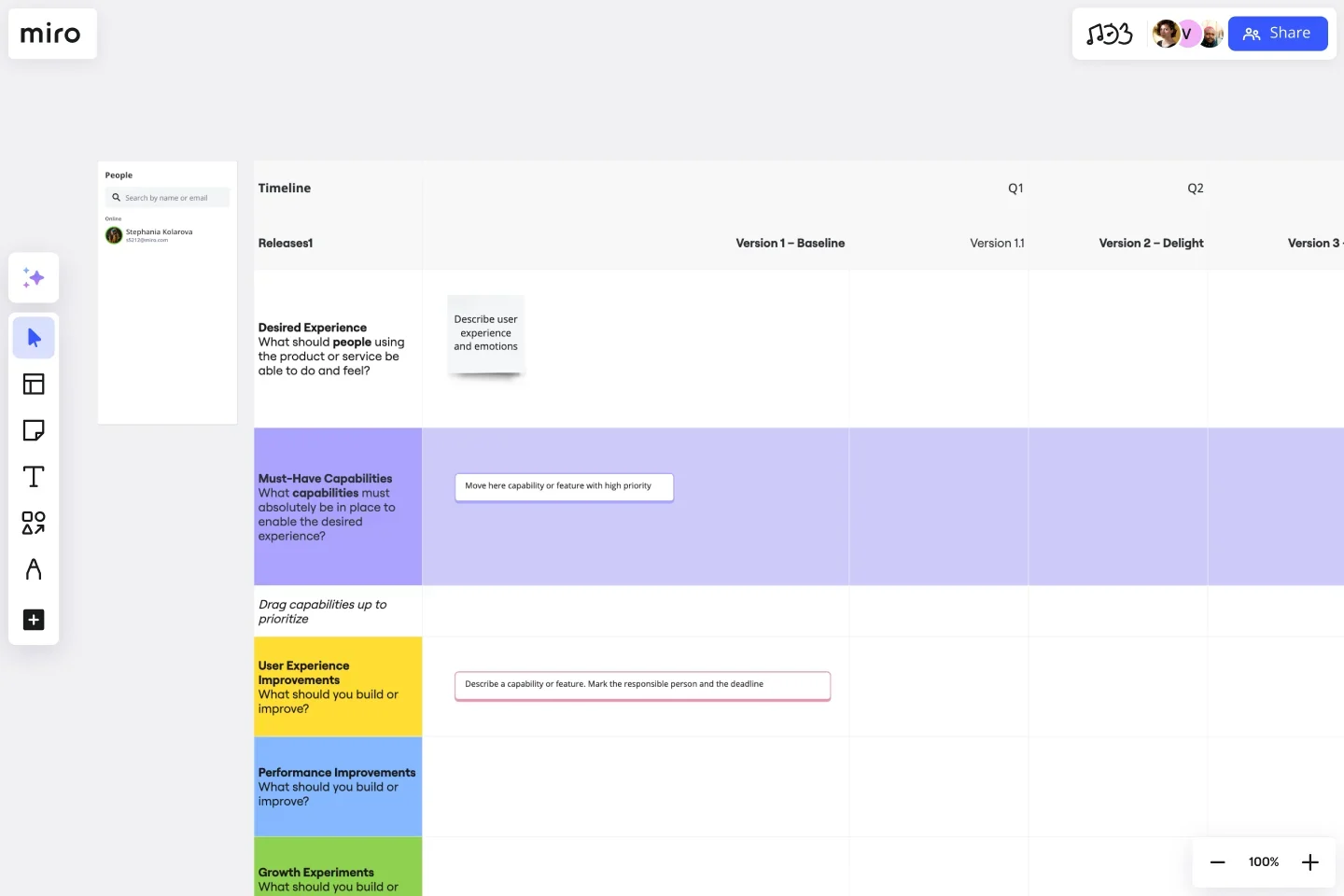
Shows the specific features and functionality you’re building. Development teams and designers rely on these software product roadmaps to understand what’s in scope and what’s coming next. Feature roadmaps help you prioritize which capabilities to build first based on customer needs, business value, and technical dependencies.
Best for: Engineering teams, product managers, designers Time horizon: 3-12 months When to use: Internal planning and sprint alignment
Strategy roadmaps

Highlights high-level objectives and initiatives without getting into feature-level detail. These product roadmap examples connect your product work to broader business goals—things like entering new markets, improving unit economics, or building platform capabilities. Executives and investors want to see strategy, not implementation specifics.
Best for: Leadership, board members, investors Time horizon: 1-3 years When to use: Quarterly business reviews, funding discussions
Release roadmaps
Maps out upcoming product releases and updates on a calendar. Marketing, sales, and customer success teams use these to plan campaigns, train customers, and set expectations. Release roadmaps coordinate launches across functions so everyone’s ready when new capabilities ship.
Best for: Go-to-market teams, customer success Time horizon: 1-6 months When to use: Launch planning and coordination
Technology roadmaps
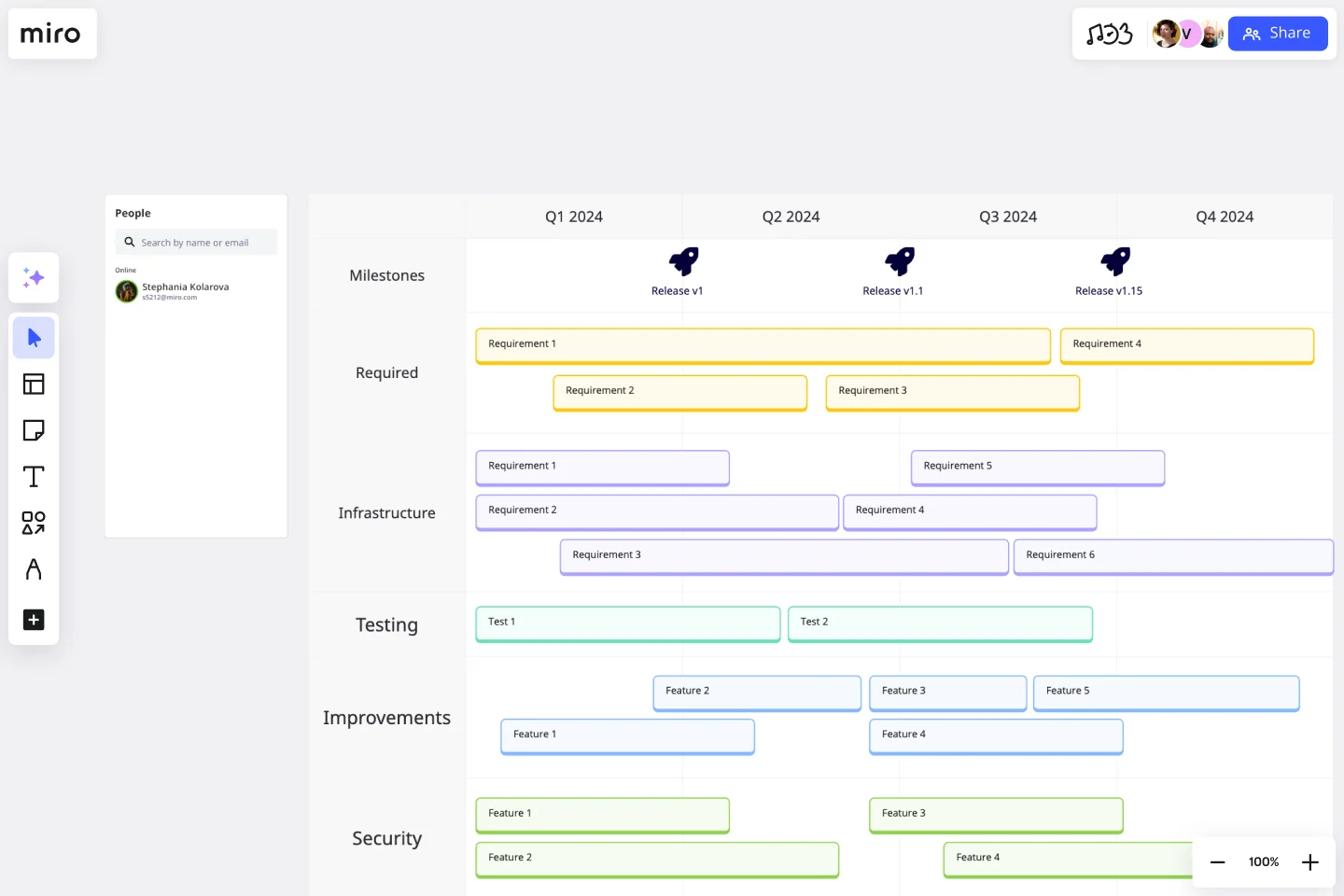
Outlines the evolution of the technical architecture and the infrastructure improvements needed to support the product strategy. These help engineering leaders plan capacity, manage technical debt, and make build-vs-buy decisions. Technology roadmaps often align with compliance requirements or platform migrations.
Best for: Engineering leadership, IT, infrastructure teams Time horizon: 6-24 months When to use: Technical planning and resource allocation
Now-Next-Later roadmaps
This approach organizes initiatives by urgency without setting specific dates. “Now” items are in progress, “Next” are prioritized for the near future, and “Later” are for future exploration. This format gives you flexibility to adapt as you learn, which is ideal for fast-moving environments where strict timelines can lead to false commitments.
Best for: Agile teams, startups, rapidly changing markets Time horizon: Flexible (no specific dates) When to use: When uncertainty is high and learning fast matters
Outcome-based roadmaps
This type focuses on business results, such as increasing retention by 20%, reducing churn by 15%, or improving NPS by 10 points, instead of just listing features. It gives teams flexibility in how they reach goals and connects product work directly to the metrics that matter to leadership. This approach works well with OKR frameworks.
Best for: Product leaders, executives focused on metrics Time horizon: 6-18 months When to use: OKR planning, performance tracking
Portfolio roadmaps
Manages multiple products or workstreams simultaneously. Shows dependencies, resource allocation, and strategic alignment across your product suite. Critical for product leaders managing teams of PMs who need to coordinate releases and prevent resource conflicts.
Best for: CPOs, VPs of Product, multi-product organizations Time horizon: 12-36 months When to use: Cross-product planning and resource management
Theme-based roadmaps
Groups work by strategic themes (e.g., “Improve onboarding,” “Scale infrastructure,” “Enter enterprise market”) rather than specific features. This communicates strategic intent without prescribing exact solutions. Great for aligning executives while giving teams implementation flexibility.
Best for: Executive communication, strategic planning Time horizon: 6-18 months When to use: Board updates, company all-hands
Roadmap type comparison
Product Roadmap Types: Comprehensive Comparison
Dimension | Feature Roadmap | Strategy Roadmap | Release Roadmap | Technology Roadmap | Now-Next-Later Roadmap | Outcome-Based Roadmap | Portfolio Roadmap | Theme-Based Roadmap |
Roadmap Type | Feature Roadmap | Strategy Roadmap | Release Roadmap | Technology Roadmap | Now-Next-Later Roadmap | Outcome-Based Roadmap | Portfolio Roadmap | Theme-Based Roadmap |
Best For | Engineering teams, product managers, designers | Leadership, board members, investors | Go-to-market teams, customer success | Engineering leadership, IT, infrastructure teams | Agile teams, startups, rapidly changing markets | Product leaders, executives focused on metrics | CPOs, VPs of Product, multi-product organizations | Executive communication, strategic planning |
Time Horizon | 3-12 months | 1-3 years | 1-6 months | 6-24 months | Flexible (no specific dates) | 6-18 months | 12-36 months | 6-18 months |
Primary Focus | Specific features and functionality being built | High-level objectives and business initiatives | Upcoming product releases and launch coordination | Technical architecture evolution and infrastructure | Initiative urgency and priority without dates | Business results and metric targets | Multiple products and cross-product coordination | Strategic themes without prescribing solutions |
Level of Detail | Detailed (specific capabilities and tasks) | High-level (strategic direction only) | Medium (release features and timelines) | Technical (infrastructure and architecture) | Variable (detailed for Now, high-level for Later) | Medium (outcomes with supporting initiatives) | High-level (cross-product strategic view) | High-level (themes and strategic intent) |
Key Benefit | Clear delivery schedule for teams | Aligns product with business goals | Coordinates cross-functional launches | Manages technical evolution systematically | Maximum adaptability to change | Focuses on results over features | Cross-product alignment and resource management | Strategic communication without prescribing solutions |
When to Use | Internal planning and sprint alignment | Quarterly business reviews, funding discussions | Launch planning and coordination | Technical planning and resource allocation | When uncertainty is high and learning fast matters | OKR planning, performance tracking | Cross-product planning and resource management | Board updates, company all-hands |
Primary Audience | Internal development and design teams | External stakeholders and leadership | Marketing, sales, customer-facing teams | Engineering and IT departments | Cross-functional teams in fast-paced environments | Leadership focused on business metrics | Product leadership managing multiple products | Executive leadership and board members |
Update Frequency | Monthly or per sprint | Quarterly or bi-annually | Weekly or bi-weekly | Quarterly | Continuously as priorities shift | Quarterly aligned with OKR cycles | Quarterly or as strategic priorities change | Quarterly or bi-annually |
Flexibility Level | Medium (features can be reprioritized) | Low (strategic direction is stable) | Low (launches are time-sensitive) | Medium (technical plans adjust to needs) | Very High (designed for continuous adaptation) | High (focuses on outcomes, not solutions) | Medium (balances multiple product needs) | Medium (themes are stable, solutions flexible) |
Success Metrics | Features delivered on schedule | Strategic goals achieved | Successful launches and GTM execution | Technical milestones completed | Velocity and throughput | OKR achievement and metric movement | Portfolio health and resource efficiency | Organizational alignment and clarity |
Common Formats | Timeline with features, Gantt charts | Quarterly themes, strategic pillars | Calendar view, milestone timeline | Architecture diagrams, dependency maps | Three-column board (Now/Next/Later) | OKR trees, metric dashboards | Multi-product timeline, dependency matrix | Theme swimlanes, strategic boxes |
Typical Challenges | Can become feature factory without outcome focus | Too high-level for execution teams | Pressure to hit fixed dates regardless of quality | May disconnect from customer value | Later column becomes wish list without governance | Requires discipline to measure outcomes | Complexity managing multiple products | Can be too abstract without supporting detail |
Integration Needs | Jira, Azure DevOps, development tools | OKR platforms, business intelligence tools | Marketing automation, CRM systems | Confluence, documentation tools, code repos | Agile tools for Now items, lightweight for Later | OKR software, analytics platforms | Project management, resource planning tools | Presentation tools, strategy platforms |
Coordination Required | Development and design teams | Executive leadership and board | Marketing, sales, support, product | Engineering, IT, security teams | Product, engineering, stakeholders | Product, analytics, leadership | Multiple product teams, resource managers | Leadership, product, all functions |
Product roadmap vs product backlog: What’s the difference?
These terms get confused constantly. Here’s the distinction:
Product roadmap:
- Strategic, high-level plan
- Shows why you’re building and what outcomes you’re driving
- Communicates vision to stakeholders
- Time horizon: Months to years
- Audience: Everyone—executives, teams, customers
Product backlog:
- Tactical, granular task list
- Lists specific features, bugs, and tech debt to complete
- Guides sprint planning and daily work
- Time horizon: Days to weeks
- Audience: Development teams
The relationship: Your roadmap sets strategic priorities (themes, initiatives, goals). Your backlog breaks those priorities into user stories and tasks that teams can execute in sprints.
Think of it this way: The roadmap is your GPS showing the destination and route. The backlog is your turn-by-turn directions for today’s drive.
Miro helps you connect the roadmap strategy, which lives on the canvas where teams collaborate, and syncs it to Jira or Azure DevOps for backlog execution. Strategy and execution stay linked instead of drifting apart.
Product roadmap examples
New market expansion roadmap
A SaaS company entering a new geographic or industry market uses a roadmap to sequence the work required. This might include adapting the product for local regulations, refining the go-to-market strategy, building partnerships, adjusting pricing models, and coordinating sales and customer support efforts.
The roadmap shows phases: initial market research and validation (months 1-3), product localization and pilot customers (months 4-6), coordinated launch and sales enablement (months 7-9), and scaling based on early learnings (months 10-12). Each phase has clear success criteria and decision points.
Mobile app feature rollout roadmap
A mobile development team plans the release of new features like in-app messaging, payment integration, and performance enhancements. The roadmap includes phases for design exploration, development sprints, user testing with select beta groups, and staged rollouts to specific user segments.
Phased releases let teams gather feedback and catch issues before full deployment. The roadmap ensures features align with user needs and product strategy while minimizing disruption. Teams can adjust based on real-time data instead of committing to a full launch blindly.
Internal system upgrade roadmap
An enterprise guides internal system upgrades for key infrastructure and operational systems. The roadmap helps IT teams plan infrastructure upgrades, schedule software updates, and train teams while ensuring minimal disruption to daily operations.
This includes phases for dependency mapping, scheduling downtime windows, testing in staging environments, and rolling out changes in stages. The roadmap identifies risks early—like teams that depend on legacy systems—so IT can plan migrations carefully.
How to create a product roadmap
Learning to build an effective product roadmap requires a structured approach. Here’s how to develop a product roadmap that drives results:
1. Ground it in strategy first
Lock down your product vision and how it supports business goals. Without this foundation, you’re just building a feature wish list that chases shiny objects instead of driving outcomes.
Start by answering: What problem are we solving? Who are we solving it for? What does success look like in 6 months? In 2 years? How does this product move our company closer to its mission?
Use Miro’s PRD Template to document objectives clearly when creating a product roadmap. Get alignment from leadership on strategic priorities before you start slotting features into quarters. This prevents the painful “wait, that’s not our strategy” conversation after you’ve already done the work.
2. Get stakeholder input early
Involve product, engineering, design, sales, leadership, and customer-facing teams from the start. Their insights help prevent surprises later, such as discovering that a “simple feature” actually requires six months of infrastructure work, or learning that sales has promised something you’re not planning to build.
Run a collaborative roadmapping workshop in Miro where stakeholders contribute simultaneously. Use breakout groups to gather input on customer pain points, technical constraints, and market opportunities. Synthesis happens visually, so everyone can see how their input shaped the priorities in your product development roadmap. Check our video below on how to build a roadmap in Miro:
This isn’t about design-by-committee. You’re gathering intelligence to make better decisions, not letting everyone vote on the roadmap. Product management still owns the final call, but you’re making it with complete information.
3. Prioritize ruthlessly
Stop guessing. Use RICE (Reach, Impact, Confidence, Effort) or MoSCoW (Must-have, Should-have, Could-have, Won’t-have) to prioritize based on data, not whoever lobbies hardest.
RICE helps you score each initiative:
- Reach: How many users/customers does this impact?
- Impact: How much does it move key metrics?
- Confidence: How certain are you about reach and impact?
- Effort: How much work does this require?
Score each factor, calculate (Reach × Impact × Confidence) divided by Effort, and rank your initiatives. The highest scores win. This method doesn’t remove judgment—you’ll still make strategic choices—but it helps prevent the loudest voice from dominating your product roadmap strategy.
Focus on high-impact work that delivers measurable value. If an initiative doesn’t clearly connect to a strategic goal, it doesn’t belong on your product roadmap. Be willing to say no, even to good ideas that don’t fit your current priorities.
4. Set realistic timelines
Break your product roadmap into now (0-3 months), next (3-6 months), and later (6+ months). This gives stakeholders a sense of sequence without false precision that kills trust when dates slip.
Be honest about dependencies and risks when creating a product roadmap. If you need infrastructure work before you can build customer-facing features, show that clearly. If regulatory approval could delay a launch, call it out. Transparency builds credibility.
Stay flexible, because product roadmaps change as you learn.
5. Keep it current
Review your product development roadmap monthly with stakeholders. Invite feedback, celebrate what you learned, and adjust priorities based on new information.
Markets shift. Customer needs evolve. Technical challenges emerge. Your product roadmap should reflect reality, not wishful thinking from three months ago. Schedule regular roadmap reviews where you evaluate:
- What did we ship? What did we learn?
- What changed in the market or with customers?
- Are our priorities still right, or should we adjust?
- What new information do we have that changes our thinking?
A stale product management roadmap is worse than having no roadmap at all. It can create a false sense of alignment when your team is actually moving in different directions.
Best practices for a successful product roadmap
Keep it simple and focused
Your roadmap should give a clear, high-level view of direction, not a detailed project plan. Adding too many details can confuse stakeholders and hide the main strategy you want to communicate.
Stick to major initiatives, key milestones, and important outcomes. Details belong in project plans, specs, and backlogs that link back to roadmap goals. When executives glance at your roadmap, they should immediately grasp where you’re headed and why.
Simplicity also means knowing your audience. The roadmap you show the board looks different from the one you share with engineering. Tailor the level of detail to what each group needs to make decisions and do their jobs effectively.
Engage stakeholders regularly
Regular engagement keeps your roadmap relevant and builds shared ownership. Whether you’re working with developers, sales teams, or executives, keep everyone in the loop about progress and changes.
This transparency keeps everyone aligned and encourages collaboration. You’ll catch issues early, such as capacity constraints or conflicting priorities, before they disrupt your plans. Regular check-ins also bring out valuable feedback to help you improve and adjust.
Adapt to changes
A roadmap should be a flexible tool, not a rigid contract. Market conditions shift. Customer feedback reveals new insights. Technical discoveries change what’s possible. Be ready to adjust priorities when the situation demands it.
Adapting quickly helps you stay competitive and keeps your roadmap aligned with long-term goals. Flexibility is not a weakness; it’s a way to respond to real changes. Just make sure your adjustments are strategic, not quick reactions that unsettle your team.
Measure progress
Track your progress against the goals and milestones outlined in your roadmap. This helps you understand whether product development aligns with the original plan and whether adjustments are needed.
Regular reviews also provide opportunities to celebrate wins and address blockers slowing you down. By keeping a pulse on roadmap progress, you make more informed decisions and keep the product on track toward objectives.
Moladin doubled their story points with Miro by ensuring everyone understood how their work connected to the bigger picture. Their CPO said: “Everyone now has a clear view of how their work connects to the bigger picture. It’s more than just a tool; it’s an essential part of how we innovate and deliver with confidence.”
Communicate roadmap changes
When your roadmap changes, clear communication is essential. Whether it’s a shift in priorities, timeline adjustments, or new features being added, inform all relevant stakeholders promptly.
This helps prevent confusion and misalignment, making sure everyone stays informed and understands the reasons for changes. Explain the “why”—what you learned that led to the change—not just the “what.” Giving context builds trust.
Common product roadmap mistakes (and how to avoid them)
Even experienced teams make these product roadmap mistakes. Here’s how to prevent them:
Mistake 1: Confusing product roadmaps with project plans
Product roadmaps show strategic direction, explaining what problems you’re solving and why. Project plans cover every task, dependency, and deadline. Mixing them up can overwhelm stakeholders with details or leave teams without clear actions.
Fix: Keep product roadmaps high-level (themes, initiatives, outcomes). Use tools like Jira for granular task tracking that links back to roadmap goals. Your product roadmap answers “what and why,” your project plan answers “how and when exactly.”
Mistake 2: Overcommitting to timelines
Dates turn into promises. When you inevitably need to adjust, teams lose trust in the product roadmap entirely. The pressure to hit arbitrary dates leads to cutting corners or shipping half-baked features.
Fix: Use now-next-later or quarterly themes instead of specific dates when building a product roadmap. Focus on the order of work and priorities, not fixed delivery dates. When you do commit to dates, such as for coordinated launches, be clear about what might cause changes and how you’ll communicate them.
Mistake 3: Building in isolation
Product managers who create product roadmaps alone miss critical technical constraints, customer insights, and execution realities. The result is a beautiful document that’s completely disconnected from what’s actually possible or valuable.
Fix: Run collaborative product roadmapping sessions in Miro where engineering, design, sales, and leadership contribute simultaneously.
Mistake 4: Feature factories
Product roadmaps become lists of features to ship, disconnected from outcomes or strategy. Teams build fast but nothing moves business metrics. You’re busy but not effective.
Fix: Frame every initiative as: Problem → Outcome → Solution.
Mistake 5: Set it and forget it
Markets shift. Priorities change. Customers provide new feedback. Static product roadmaps become fiction—a document that describes what you thought six months ago, not what you’re actually doing now.
Fix: Review product roadmaps monthly. Invite feedback, celebrate what you learned, and adjust.
Choosing a product roadmap tool
Your product roadmapping tool shapes how effectively you plan, collaborate, and communicate. Here’s what to look for:
Ease of use
Your product roadmap tool needs to be intuitive so everyone can contribute without a steep learning curve. If stakeholders can’t quickly understand and interact with the product roadmap, adoption stalls and it becomes another document people ignore.
Powerful collaboration features
Collaboration is key to successful product roadmapping. You need tools that support both real-time and asynchronous work, such as commenting, tagging, real-time editing, and visual co-creation.
Integration with existing systems
Your product roadmap tool should integrate easily with the platforms your team already uses. Disconnected tools create information silos and force people to manually sync data across systems—a recipe for outdated product roadmaps.
AI capabilities
Product roadmap tools with AI capabilities make a huge difference in speeding up workflows, aligning teams, and developing strategy. The right AI features help you synthesize research faster, identify patterns across stakeholder input, and make smarter prioritization decisions when creating a product roadmap.
Why visual-first roadmapping works
Traditional product roadmap tools often force you into rigid formats like Gantt charts, spreadsheets, or linear timelines. But product roadmap strategy isn’t always linear. It’s often messy, collaborative, and always changing.
Miro’s canvas-based approach lets teams think visually, spot patterns, and make connections that structured tools hide. You’re not filling in forms when creating a product roadmap—you’re co-creating strategy in real-time with your whole team in the room (or on Zoom).
Plus, Miro acts as your integration hub for product roadmapping. It doesn’t replace Jira, Notion, or Azure DevOps. Instead, it’s where teams align before moving into execution tools. Your product roadmap strategy lives on the canvas where collaboration happens, then syncs to where work gets done. This helps prevent the common problem of product roadmaps and reality drifting apart because they live in separate systems.
Build your product roadmap in Miro
Ready to build a product roadmap that brings teams together and unlocks your innovation potential? With Miro, you turn strategy into action, prioritize what matters most, and build products your customers actually need.
Miro is the AI Innovation Workspace that empowers teams to co-create product roadmaps faster. Visual-first collaboration breaks down silos between product, design, and engineering. Real-time teamwork keeps everyone aligned as priorities evolve. AI-powered features help you synthesize research, prioritize initiatives, and make smarter decisions with full context.
Advice from Miro’s Chief Product & Technology Officer
Jeff Chow, Miro’s Chief Product & Technology Officer, sees three critical challenges every product team faces when roadmapping:
“Product teams risk moving fast in the wrong direction if strategy, discovery, and execution aren’t connected,” says Chow. “When teams come together with AI on a shared canvas, strategic thinking becomes visible and actionable, unified teams accelerate toward shared goals, and organizations maximize their AI investments.”
His advice for product managers building roadmaps:
- Connect strategy to execution: Don’t let your roadmap live in slides while work happens elsewhere. Keep OKRs, dependencies, and priorities visible where teams collaborate daily.
- Build what customers actually need: Use data-backed insights, not internal opinions. Validate concepts early with rapid prototyping to reduce the cost of experimentation.
- Maximize your AI coding investments: Capture clear specs, customer context, and technical decisions in one place, then deliver comprehensive specifications directly to your AI coding tools.
Learn more about Miro for Product Acceleration and how it helps teams accelerate from idea to outcome.
Get started with Miro for roadmapping
Whether you’re planning for the next quarter or the next three years, Miro gives you the flexibility to approach product roadmapping in your own way. You can use feature roadmaps, strategy roadmaps, now-next-later formats, or custom views for your stakeholders.
Start with one of our product roadmap templates, invite your team to collaborate, and watch how visual-first planning accelerates alignment. Then sync your product roadmap to Jira, Azure DevOps, or your execution tool of choice so strategy and delivery stay connected.
How La Mobilière simplified product roadmapping with Miro
La Mobilière, a leading Swiss insurance provider, struggled with complex PI Planning across 1,500 people and multiple departments. Prep work was taking days, updates were manual, and delays often put go-live dates at risk.
With Miro, they built a single source of truth for product roadmaps, sprint planning, and dependencies. Integrated with Jira, Miro made it easy to update work in real time, align stakeholders, and cut planning prep from days to minutes.
“Before, preparing physical PI Planning with printouts took a lot of time, and we did nothing with them afterwards. Now, with Miro, we save easily up to 3 days and actually work with the roadmap after planning too.”
— Olivier Fischer, Release Train Engineer
Product roadmap FAQs
How does Miro help my team collaborate on a product roadmap?
Miro gives your team one shared space to build and refine product roadmaps together. Whether you’re co-creating in real time or adding input asynchronously, everyone can align on priorities, milestones, and dependencies. Visual collaboration breaks down silos so product, engineering, design, and leadership work from the same source of truth.
What’s the difference between a product roadmap and a product strategy?
Your product strategy defines the high-level approach to achieving your vision—it answers “how will we win?” Your product roadmap translates that strategy into a visual plan showing what you’ll build, in what order, and why. Strategy is conceptual; the product roadmap makes it tangible and actionable.
How often should I update my product roadmap?
Review your product roadmap monthly with key stakeholders. Markets shift, customer feedback reveals new insights, and technical realities change what’s possible. Regular reviews keep your product development roadmap aligned with reality instead of becoming outdated fiction. Adjust priorities based on what you’re learning.
What does a product roadmap look like?
A product roadmap can take many visual forms depending on your audience and needs. Common formats include timeline views showing features across quarters, now-next-later layouts organized by priority, swimlane views showing work by team, and theme-based roadmaps grouping initiatives by strategic goal. The best format shows your strategy clearly to your specific stakeholders.
Can Miro handle large or complex product roadmaps?
Absolutely. Miro is designed to scale with your product roadmapping workflows. Whether you’re managing a single product or an enterprise-wide portfolio, Miro handles everything from feature roadmaps to multi-team views with dependencies. You can start small and expand as needed, building custom views for different stakeholders.
Are there templates available to get started quickly?
Yes. Miroverse is our community-driven template library with thousands of product roadmap templates created by product professionals. Use these to find the right format for your needs—feature roadmaps, now-next-later views, portfolio roadmaps, and more. You can customize any template to match your product roadmapping workflow.
How does Miro integrate with tools like Jira and Azure DevOps?
Miro offers seamless two-way sync with Jira and Azure DevOps. Your product roadmap strategy lives on the Miro canvas where teams collaborate, then syncs to your execution tools where work gets tracked. This keeps strategy and delivery connected instead of drifting apart in separate systems when you’re developing a product roadmap.
Can I customize Miro to fit my specific product roadmapping process?
Yes. Miro is flexible enough to match your product roadmapping workflow. You can build custom product roadmap templates or use Blueprints to roll out preconfigured spaces that include all the boards, views, and tools your teams need. AI shortcuts help automate repetitive steps to keep your workflow moving quickly when creating a product roadmap.